Home remodel planning
Document remodel changes before dependent work continues
Keep the reason, scope, authorization and account effect of each change together.
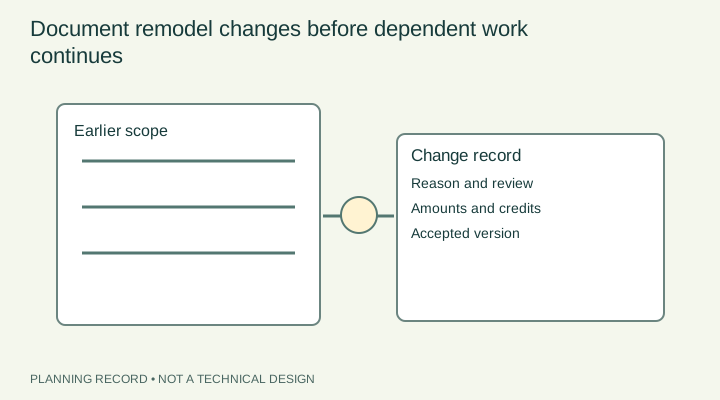
Record what changed and why
Begin a change record when a selection, site finding or authority response differs from the accepted scope. Describe the original item, the proposed replacement and the reason for the change. Keep factual observations separate from conclusions. For example, record the newly visible material and the review needed rather than declaring a concealed assembly defective from a photograph.
Attach the relevant dated sketch, quote or correspondence. If a professional or authority provided a direction, preserve their actual document and any limitations. The homeowner record should help trace the decision; it should not paraphrase a qualified finding into a broader safety or compliance statement.
Reference context: Home renovations — Office of Consumer Affairs
Identify the affected work and dependencies
Ask which drawings, products, trade tasks and finish repairs are affected. A change to one fixture may influence a cabinet order or service connection, so the visible item is only the starting point. List which work can continue and which decisions need resolution through the responsible parties.
Use the sequence planner to show dependencies without predicting a permit response or supply date. Keep the contractor's revised timing distinct from the homeowner's preferred timing. If the change involves local approvals, ask the authority or responsible applicant whether revised documents or inspections are required for the actual proposal.
Reference context: Home renovations and basements — City of Calgary · When do I need a building permit? — City of Toronto · Home renovations — Office of Consumer Affairs
Request a written price and authorization record
Ask for the scope, inclusions, exclusions, price treatment and timing effect in writing. If a cost cannot yet be defined, document how it will be established and who will authorize it. Do not substitute an online estimate or an allowance balance for agreement on the actual work.
Provincial consumer rules and contract terms may affect change handling. Ontario's renovation-rights information applies to Ontario, while Alberta provides its own contractor guidance. Verify the relevant rules for the property's location rather than applying a numerical limit copied from another province. Obtain suitable legal advice if the agreement or dispute requires it.
Reference context: Your rights when starting home renovations or repairs — Government of Ontario · Hiring a contractor — Government of Alberta
Reconcile the project after the decision
After authorization, update the current scope, product schedule and account comparison while retaining the previous version. Give the change a reference so later invoices and correspondence can identify it. If someone rejects the proposal, record that decision and the resulting next step rather than silently deleting the issue.
At closeout, review every change for its actual status: completed, cancelled, credited, still open or awaiting documents. Compare the final account with the accepted scope and authorized revisions. This produces a useful project history for future maintenance without claiming that the paperwork alone confirms technical workmanship.
Reference context: Home renovations — Office of Consumer Affairs
PUT THE GUIDE IN CONTEXT