Home remodel planning
Plan remodel work in an occupied home
Coordinate household use, restricted areas and product-related exposure questions before work begins.
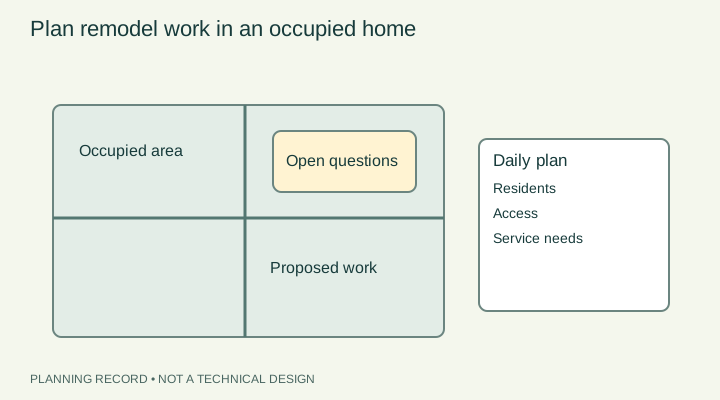
Describe what the household needs to keep using
List residents' essential routines, work hours, pets, mobility needs and the rooms or entrances they rely on. Identify whether the home has another usable bathroom or food-preparation area. These details affect planning even when they do not change the visible construction scope. Agree how private belongings and retained finishes will be protected and who will move them.
Ask the contractor to identify which areas will be restricted during each phase and how the household will receive notice of changes. A marked route on a sketch is a proposal that must be checked against actual site conditions. Do not promise continued access to an area that the work plan may need to isolate.
Reference context: Home renovations — Office of Consumer Affairs
Discuss dust, fumes and suspect materials specifically
Collect the names of proposed coatings, adhesives and other products so their instructions can be reviewed. Health Canada recommends reading labels and reducing exposure during household projects. Ask the responsible party how product instructions, ventilation, storage and occupancy will be addressed for the actual work, rather than relying on a fixed reopening time from a general article.
If work may disturb suspect asbestos-containing material or older coatings, obtain appropriate assessment and controls before disturbance. Building age and appearance are screening questions, not confirmation. Do not use a household fan, closed door or generic mask recommendation as evidence that hazardous work can proceed safely around occupants.
Reference context: Chemical safety for do-it-yourself projects — Health Canada · Health risks of asbestos — Health Canada · Lead-based paint — Health Canada
Plan services and unexpected changes
Ask the relevant trades to explain planned interruptions to water, electricity, heating or ventilation and how the household will be informed. Record the agreed process and the contact responsible for updates. Temporary arrangements should be reviewed by the responsible parties; the planning record does not authorize improvised connections.
Include a response process for unexpected site findings or loss of an essential room. Identify who decides whether the affected work pauses, how the finding is documented and how a revised scope is authorized. Keep alternative accommodation or temporary-use decisions separate from technical safety conclusions about the work area.
Reference context: Ventilation and the indoor environment — Health Canada · Home renovations — Office of Consumer Affairs
Maintain a useful daily record
Keep a brief dated log of work areas, resident concerns, announced interruptions and decisions requiring follow-up. Record facts and questions without assigning fault or diagnosing exposure. Share the relevant items through the communication process agreed with the contractor, and preserve responses with the project documents.
Before normal use resumes, ask for the applicable completion, product-use and inspection information from the responsible parties. Record incomplete work and unresolved questions separately. A tidy room or absence of an odour does not alone establish technical clearance. The occupied-home plan should help the household understand confirmed arrangements and remaining decisions.
Reference context: Chemical safety for do-it-yourself projects — Health Canada · Home renovations — Office of Consumer Affairs
PUT THE GUIDE IN CONTEXT