Home remodel planning
Sequence a remodel around decisions and dependencies
Use a planning order that can be revised by the people responsible for the work.
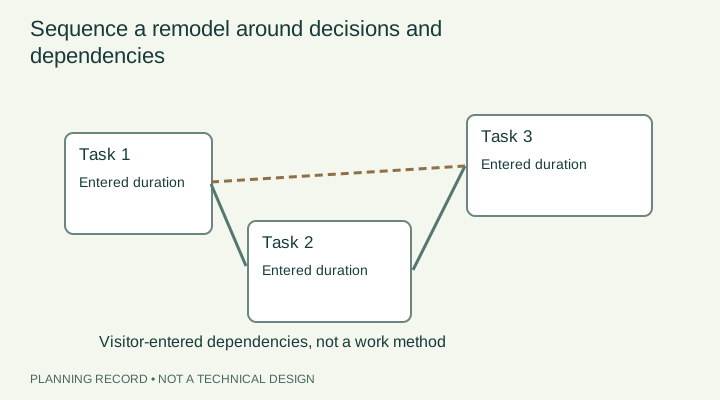
Start with decisions rather than invented durations
List the major project phases in plain language: define scope, assess unknowns, confirm design, check approvals, select products, carry out work and close out. Then identify the decisions that each phase depends on. This is more useful than assigning guessed dates to construction tasks whose requirements are not yet known.
Record the party responsible for each decision and the evidence needed to close it. A homeowner finish choice, a municipal response and a trade assessment have different owners. The planner should show those relationships without turning an unchecked box into a technical acceptance or permission to start.
Reference context: Home renovations — Office of Consumer Affairs
Place assessments and approvals before disturbance
If proposed work could disturb suspect materials, arrange the appropriate assessment before that phase is planned as executable work. Health Canada's asbestos and lead information supports taking these questions seriously without diagnosing a material from its age or appearance. A scheduling tool does not supply a safe disturbance method.
Ask the local authority and responsible applicant about approval and inspection dependencies. Calgary and Toronto publish different municipal examples; neither is a complete Canadian rule. Record any required review before purchasing dependent products or concealing work. Use the authority's actual response rather than an assumed processing interval.
Reference context: Health risks of asbestos — Health Canada · Lead-based paint — Health Canada · Home renovations and basements — City of Calgary · When do I need a building permit? — City of Toronto
Coordinate supply and trade interfaces
Identify items that require confirmed dimensions, a product selection or a prepared surface before the next party can work. Ask who verifies each interface and how that verification is documented. Cabinet fabrication, counter measurement and fixture installation illustrate why ordering and installation are separate decisions rather than one generic phase.
Use stated supplier or contractor dates as dated inputs and mark them as unconfirmed until the relevant party confirms them. Do not promise availability or convert an illustrative sequence into a guaranteed completion date. Keep alternate selections and the effect of substitutions visible so the project can be revised coherently.
Reference context: Home renovations — Office of Consumer Affairs
Include occupied use and closeout
Add household access, temporary use and protection of retained belongings as actual planning tasks. Ask how restricted areas and changes to essential services will be communicated. Where fumes, dust or suspect materials are involved, exposure controls and occupancy decisions need appropriate advice rather than a generic 'stay in another room' instruction.
Reserve a closeout phase for the agreed walkthrough, records, outstanding work and final account reconciliation. A phase marked complete should identify the evidence or party confirming it. Keep technical inspections, homeowner observations and contract acceptance distinct. The result is a transparent coordination plan that can be corrected, not a construction schedule certified by a calculator.
Reference context: Chemical safety for do-it-yourself projects — Health Canada · Home renovations — Office of Consumer Affairs
PUT THE GUIDE IN CONTEXT